Play cards with a modal command language.
pokerjoker.vim is a dependency-free browser game that explores how a Balatro-like card loop feels when the primary interface is inspired by Vim. The goal is small and focused: reach 300 chips in four hands, with three discards and a fixed +4 Mult Joker.
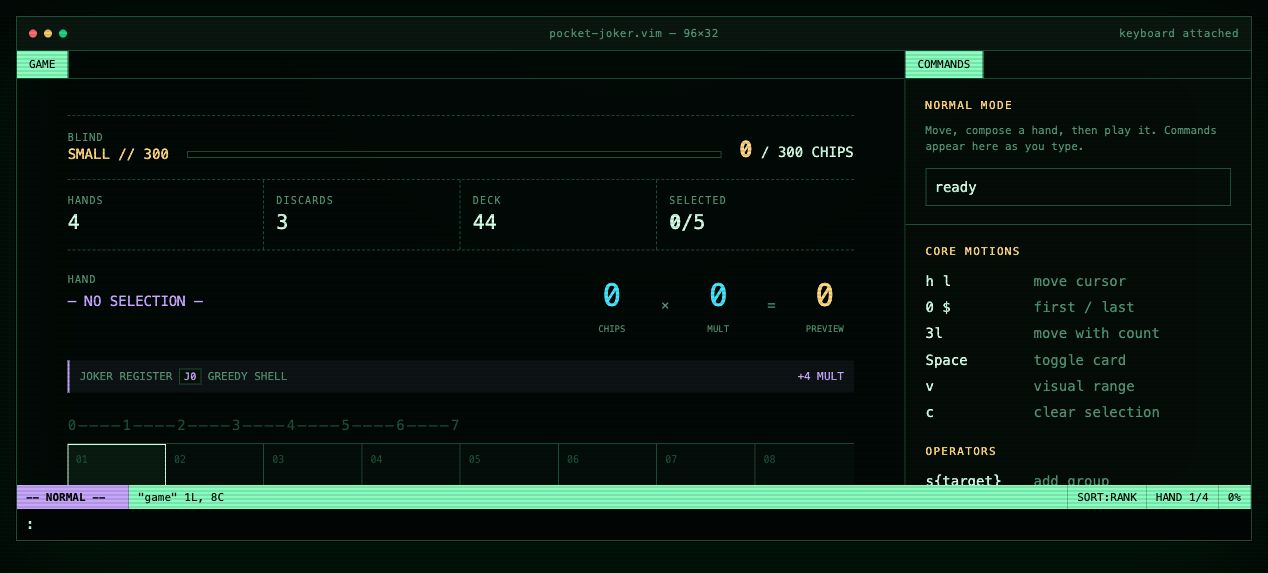
The problem
Most card games are built around pointing, clicking, and dragging. That works well, but it also hides an interesting design question: can a hand-management game feel fast and expressive if the player manipulates cards with composable keyboard commands?
This project treats the keyboard as the main interface rather than an accessibility afterthought.
Design constraints
- It should run as a static site with no packages, build step, or external assets.
- The full game should be playable with the keyboard.
- Commands should feel familiar to Vim users without requiring a full Vim clone.
- Selection, discard, play, sort, help, and restart flows should all be reachable without a pointer.
- The rules should stay compact enough for quick experimentation.
What it does
- Implements a four-hand poker round with a fixed Joker multiplier.
- Supports cursor movement with
handl, counts, first and last card jumps, and visual selection. - Uses composable commands for selecting suits, ranks, colors, face cards, and all cards.
- Provides EX-style commands such as
:select hearts,:discard black,:sort rank, and:restart. - Includes rank and suit sorting, automatic sorting for newly drawn cards, undo for selection state, and repeatable actions.
- Ships with a dependency-free browser test page.
Engineering approach
The project is plain HTML, CSS, and JavaScript. The implementation separates the deterministic deck and poker-hand evaluator from the game-state and input grammar, keeping the rules engine easier to test while the renderer stays focused on the terminal-style interface.
The command grammar borrows the parts of Vim that fit the card-table model: movement, counts, visual ranges, grouped targets, and command mode. The result is intentionally smaller than Vim, but it preserves the useful idea that a few primitives can combine into fast actions.
What I learned
Keyboard-first design changes the shape of a game. Small conveniences, such as count prefixes, repeated actions, and mode feedback, matter more when every move is typed. The experiment also reinforced how useful a tight grammar can be: the same concepts that make text editing efficient can make game actions feel deliberate and quick.